Maqâm Abu Hurayra/Tombeau Rabban Gamliel (673/1274)
Localisation
Aujourd’hui parc Ha-Sanhedrin, au sud-est de la ville.
Bibliographie
Clermont-Ganneau (1896), II, p.167-168,
177-181 ; Fischer/Taxel (2007),
p.204-284 ; Mayer/Pinkerfeld (1950), p.21-24 ;
Meinecke (1992), 4/199, 8/21, 26A/28 ; Petersen (2001),
n°159 ; Petersen (2018), p.56-60 ; Pringle (1997), p.109 ; Taragan (2000), p.117-144 ;
Taragan (2002), p.31-34
Inscriptions
RCEA 4686, 4965
Historique
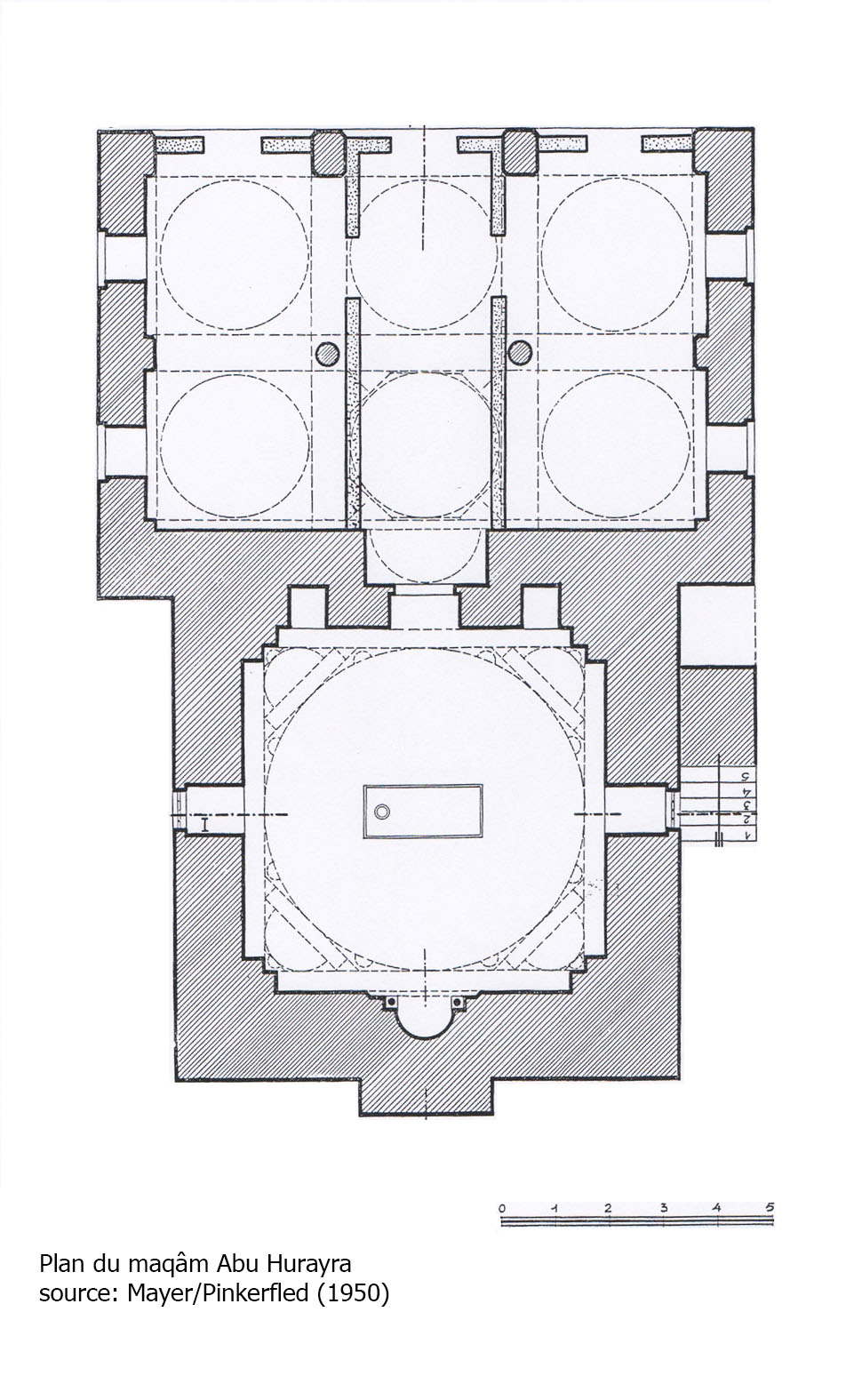
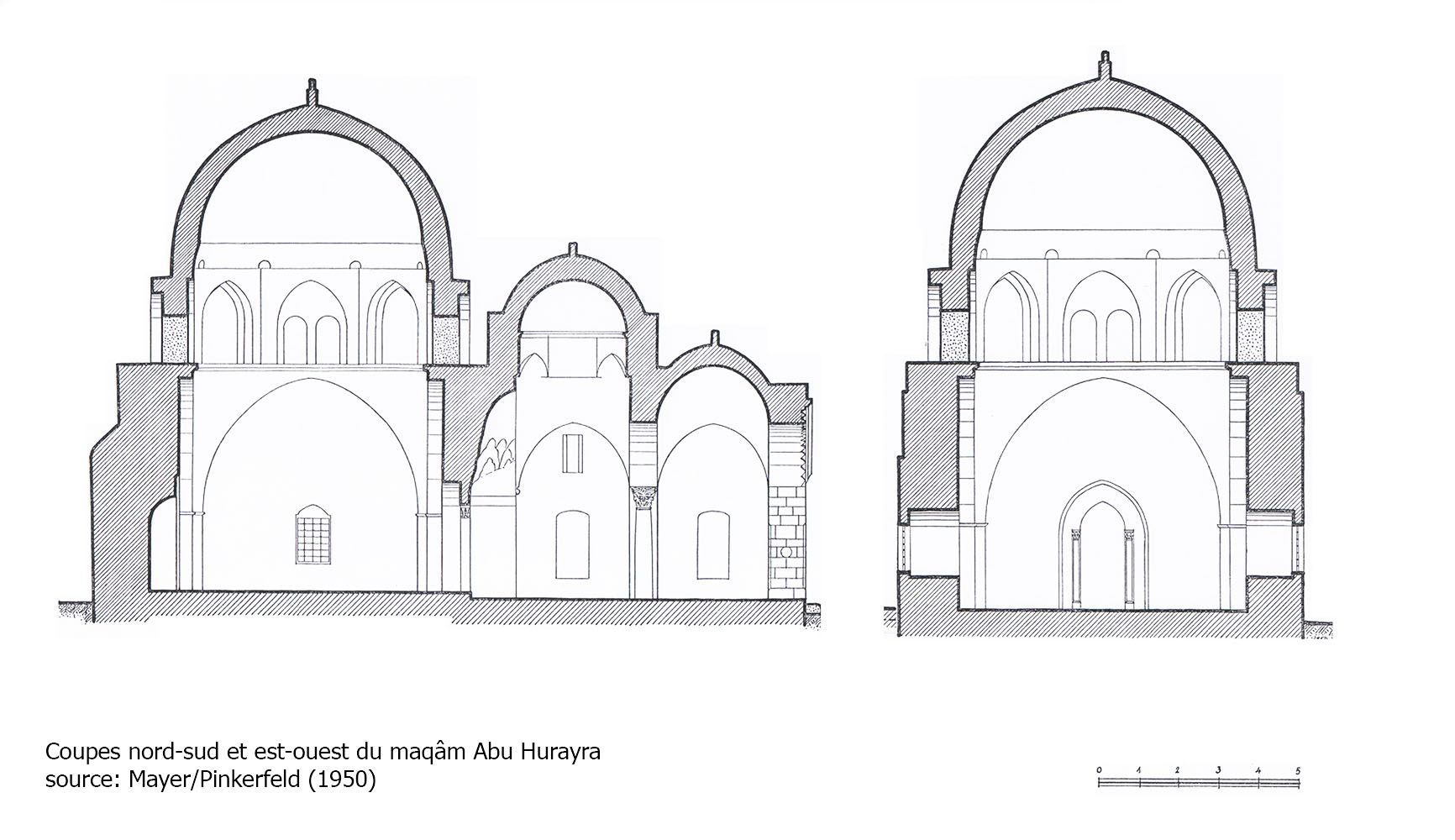
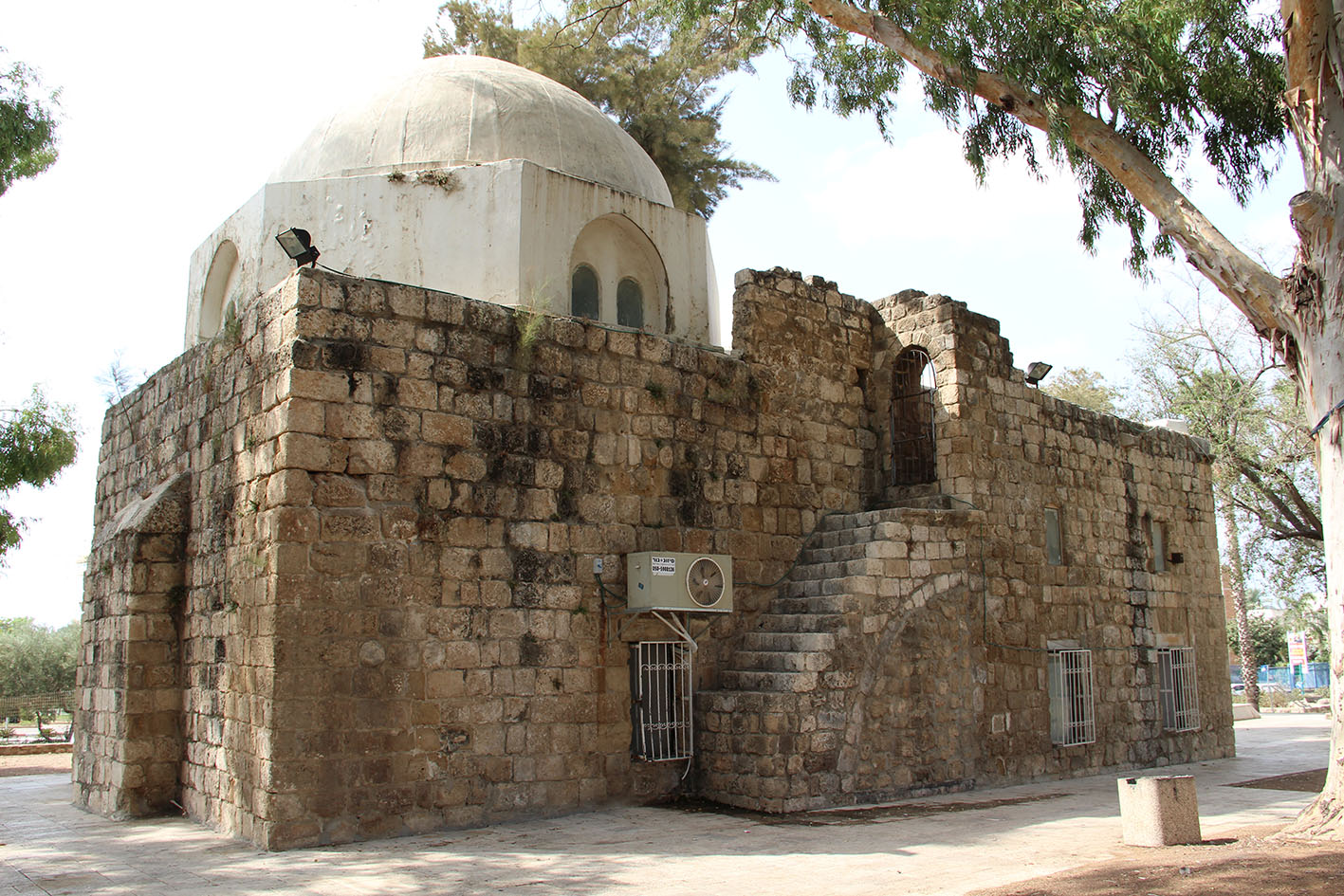
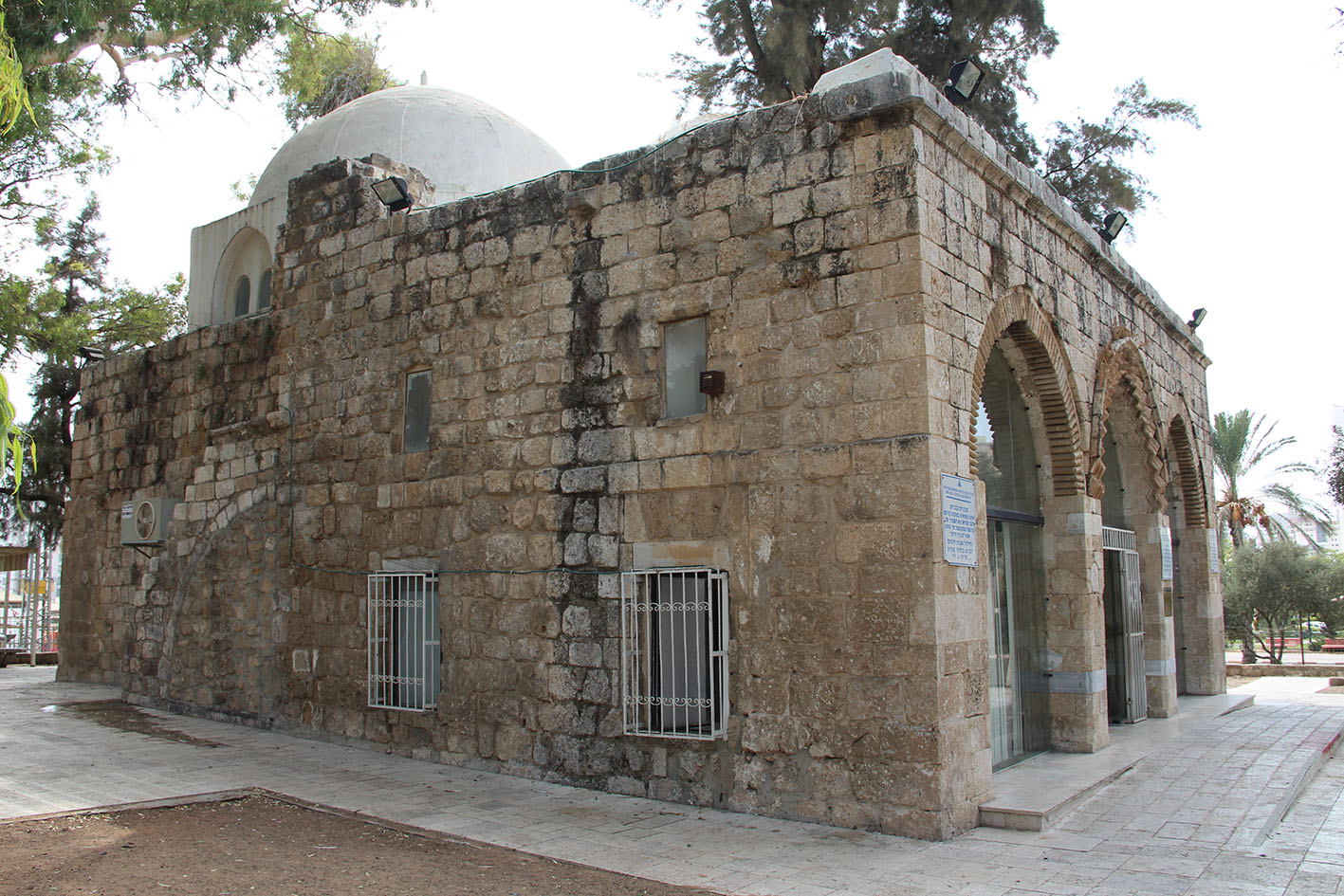
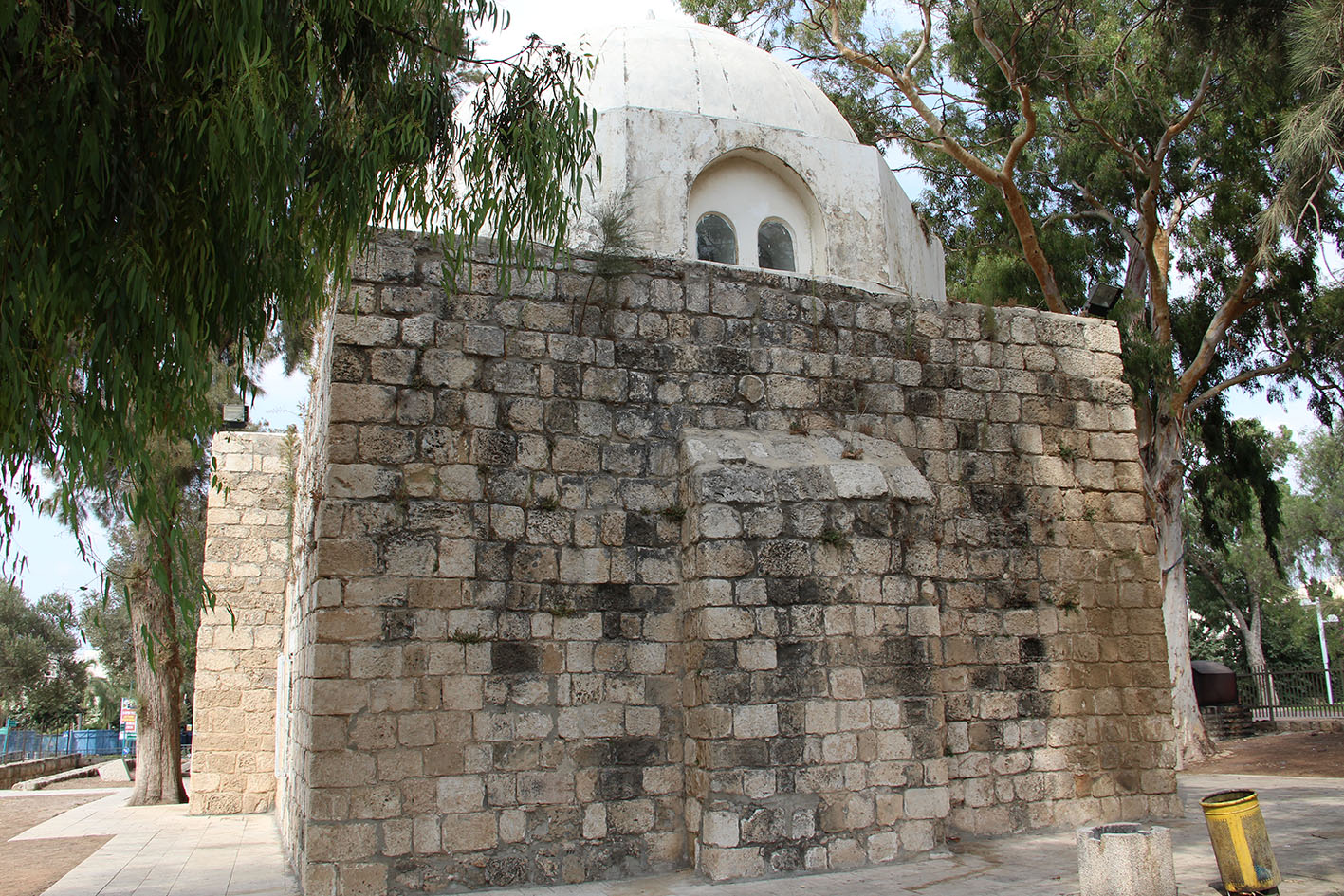
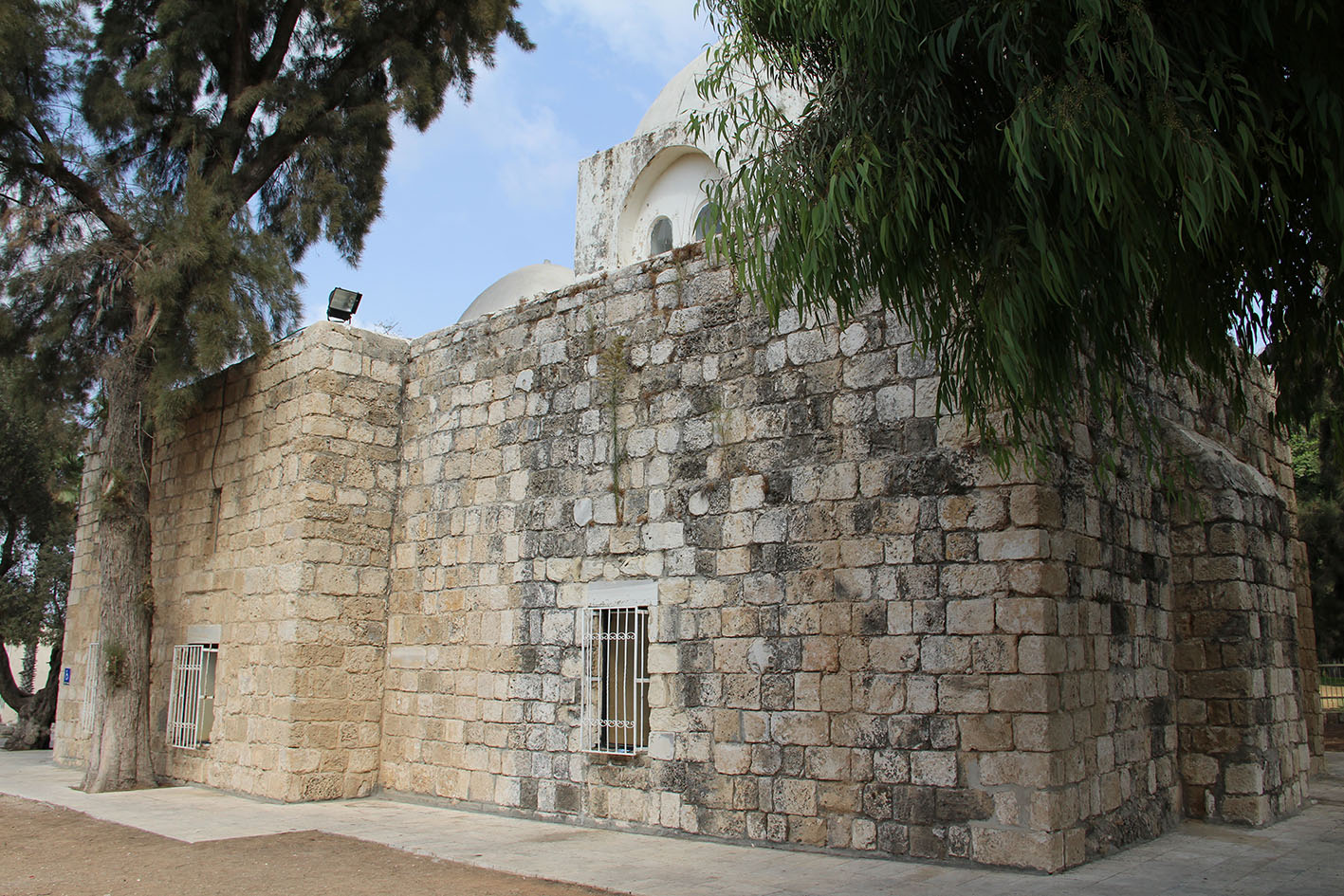
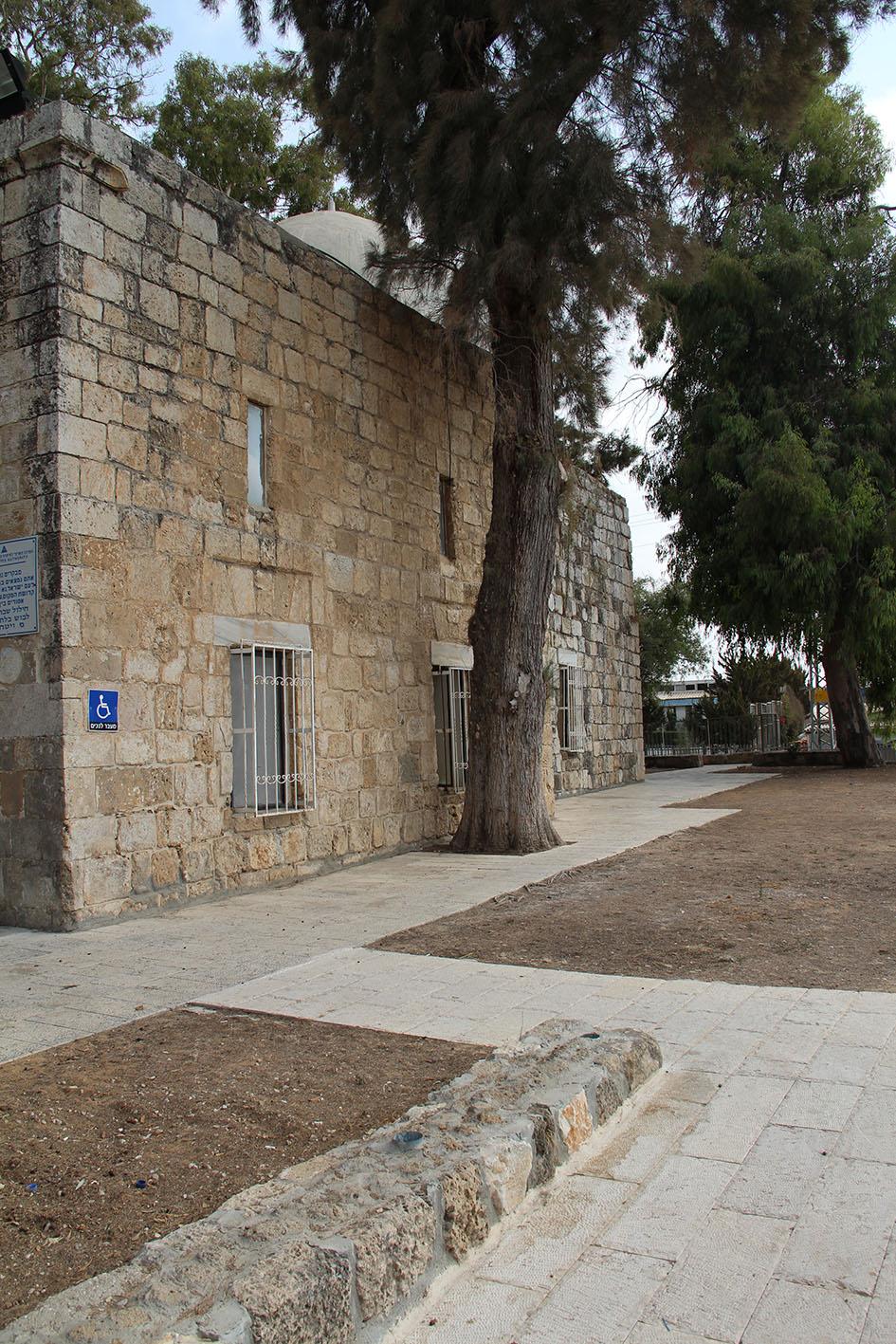
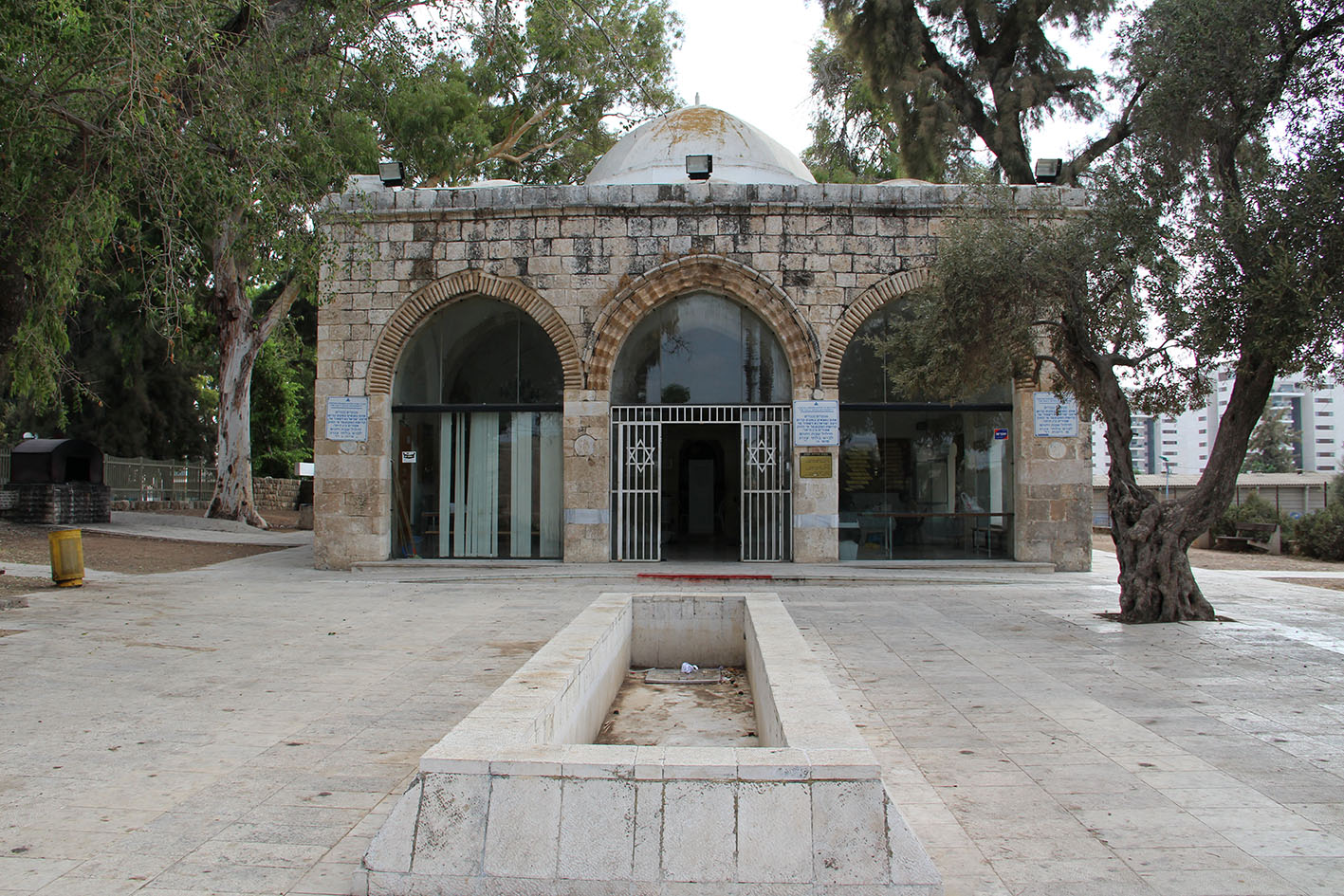
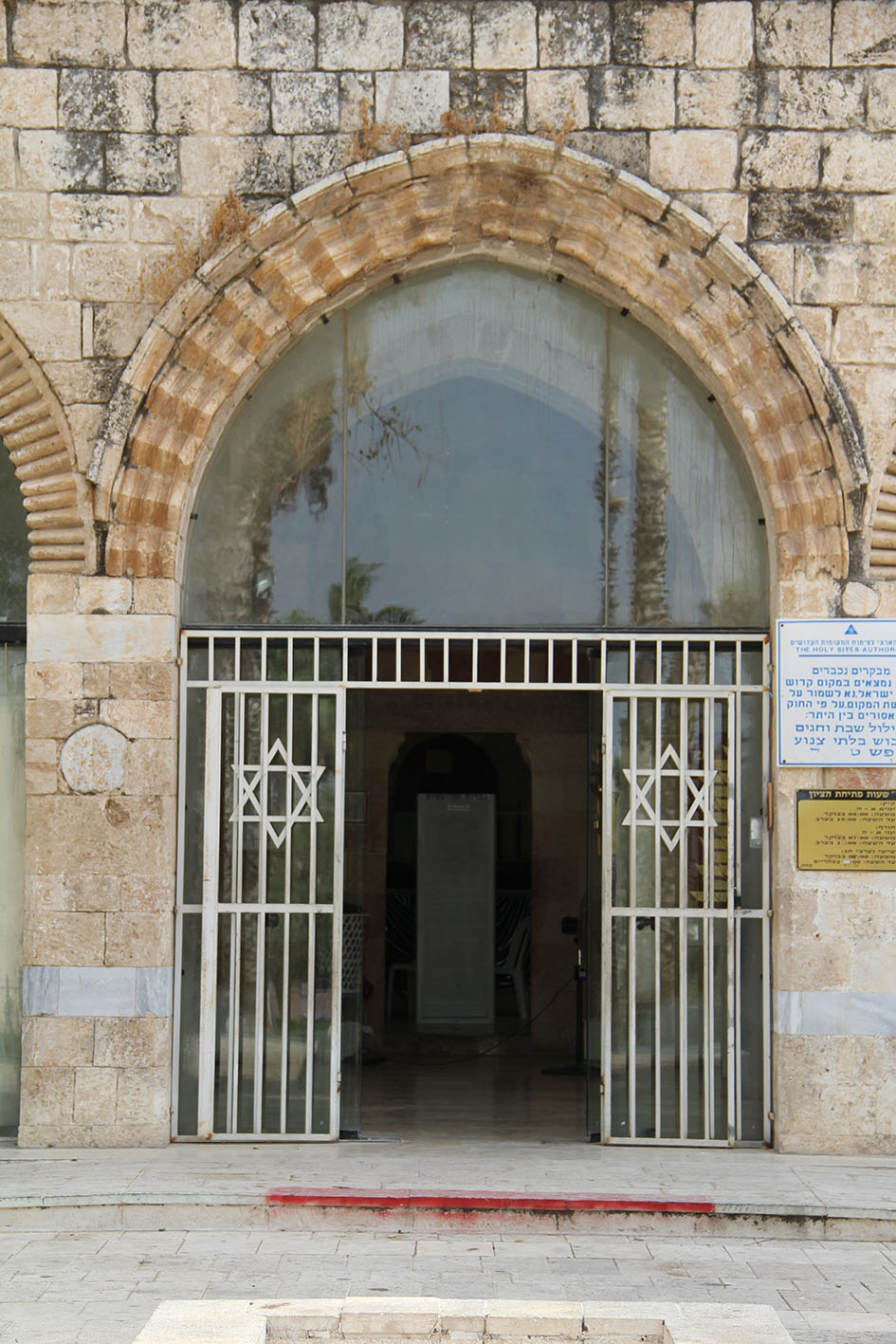
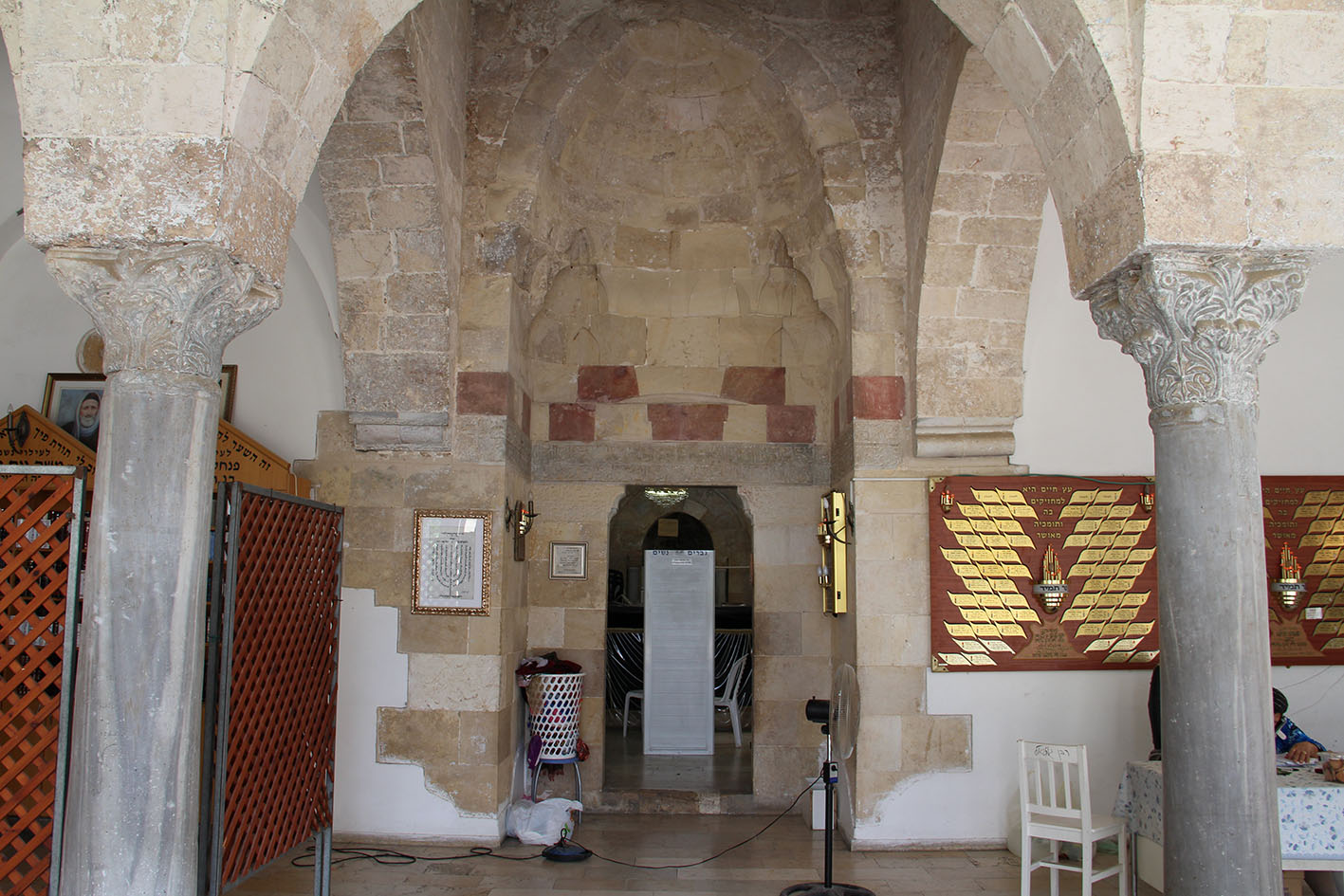
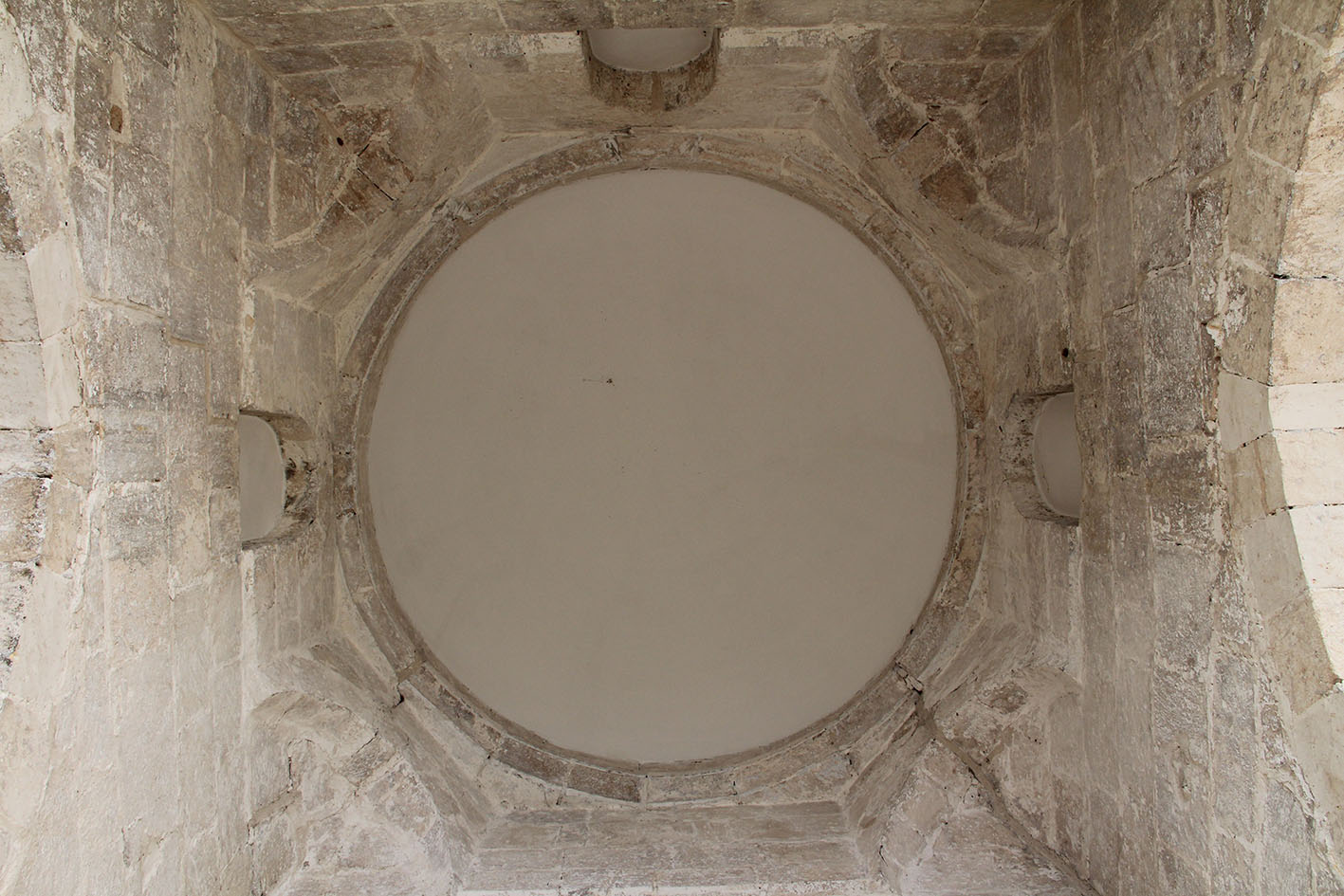
L’édifice sacré (maqâm), consiste en une salle funéraire à coupole et un avant porche (riwaq) surmonté de six coupoles, il est construit en plusieurs étapes. L’avant portique a été construit en rabi’ 673/4.IX-3.X.1274 pour le compte le sultan al-Zâhir Baybars (r.17 dhu’l-qa’da 658/24.X.1260 – 27 muharram 676/30.VI.1277). C’est le gouverneur de Ramla, Khabîb ibn Shawwar, qui a conduit les travaux ; il a utilisé de nombreux remplois Croisés (ill.10-12). En 692/1292-93, la coupole du tombeau est restaurée ou construite sous la direction de Aidamur al-Dawadâr al-Zainî (ill.15) en activité sous le règne du sultan al-Ashraf Khalîl (r.7 dhu’l-qa’da 689/11.XI.1290 – 12 muharram 693/13.XII.1293).
L’installation hydraulique (sâqîya), les canaux (qanât) et bassin (hawud) du site a été rénovés en rabi’ I 806/18.IX-17.X.1403 par al-Nâsirî Muhammad Anar ibn Anar et al-‘Alâ’î Yalbughâ.
Epigraphie
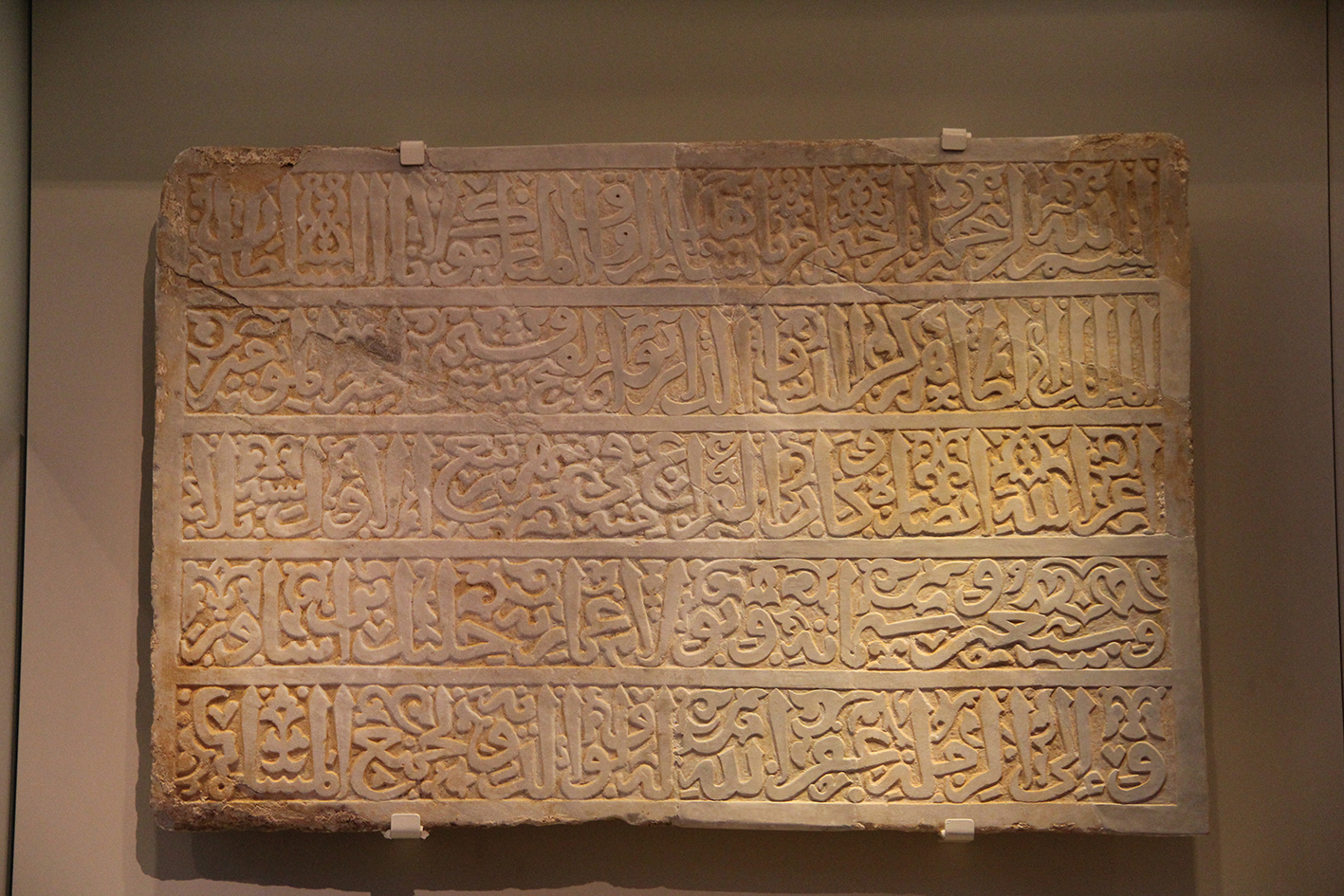
673/1274. Texte de construction 5 lignes à l’origine sur la porte de l’enceinte, aujourd’hui au Musée National (ill.21).[1]
« xxx la fondation de ce
portique béni a été ordonnée par notre maître le sultan al-Malik al-Zâhir Rukn
al-dunya wa’l-dîn Abul-Fath Baybars, l’associé de l’émir des croyants, que Dieu
glorifie ses victoires ! l’achèvement en eut lieu dans le mois de rabi’I
de l’année 673 (septembre 1274). Se chargea de sa construction Khalîl, fils de
Shawar, préfet d’al-Ramla, que Dieu lui pardonne ainsi qu’à ses père et mère et
à la totalité des musulmans ».
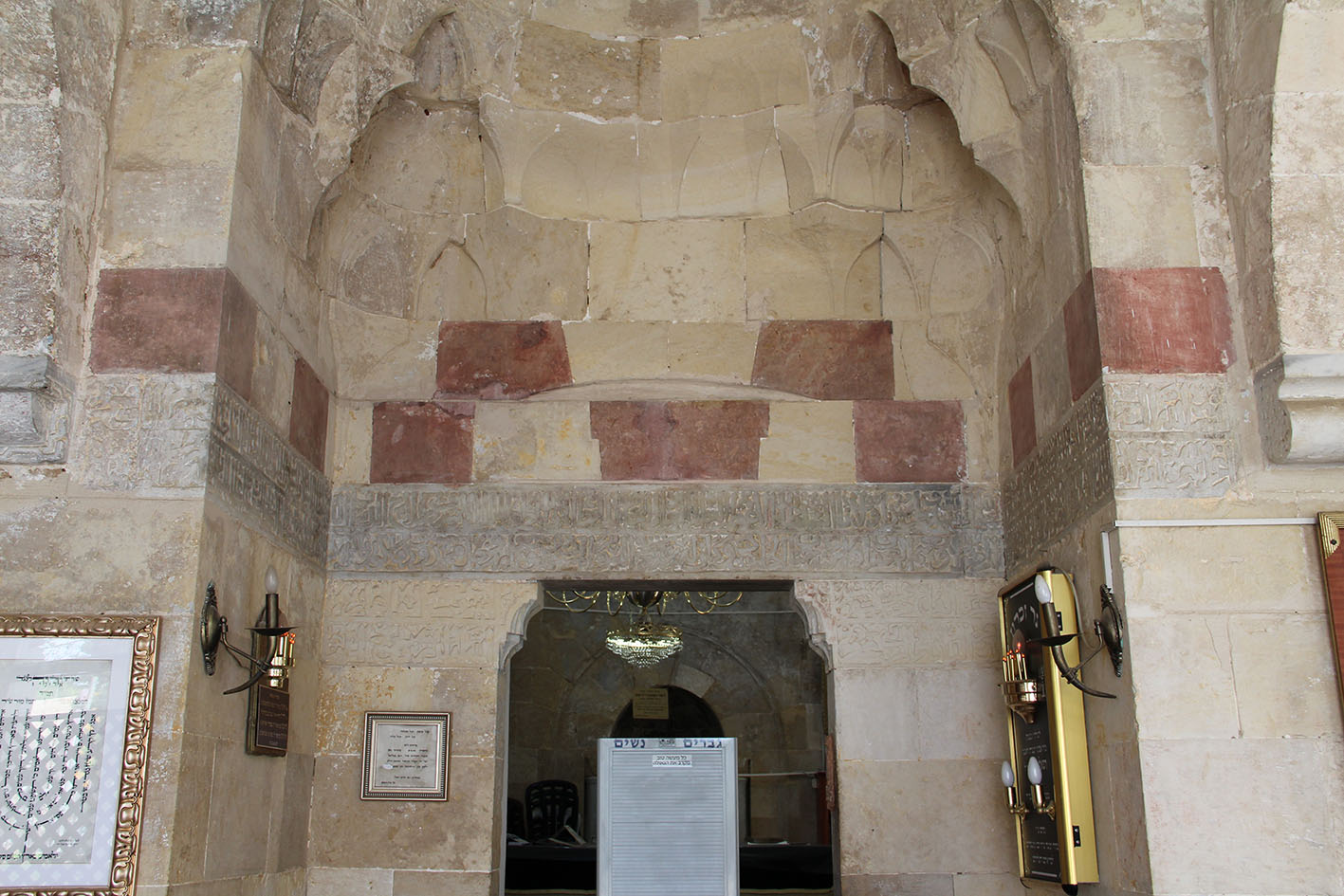
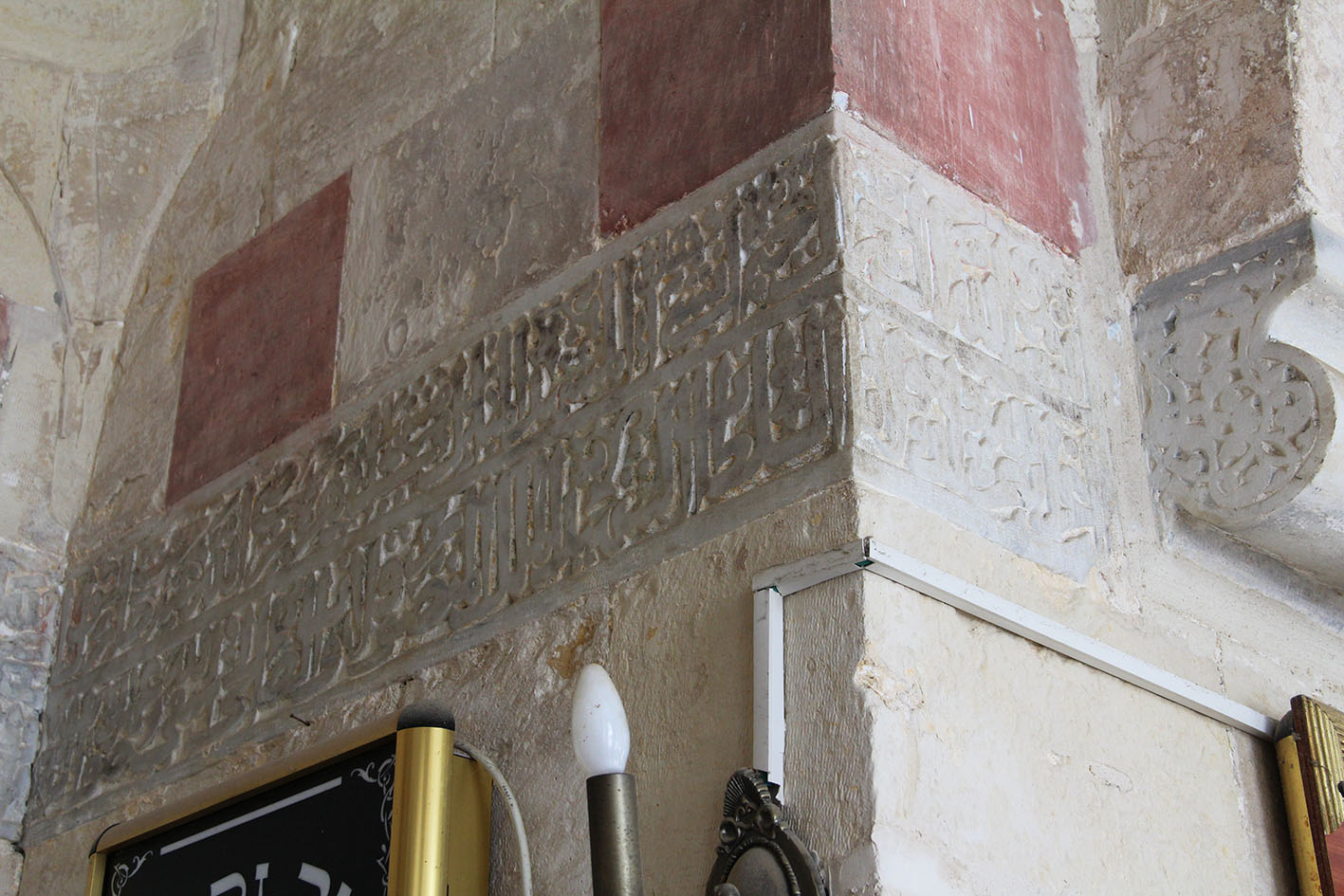
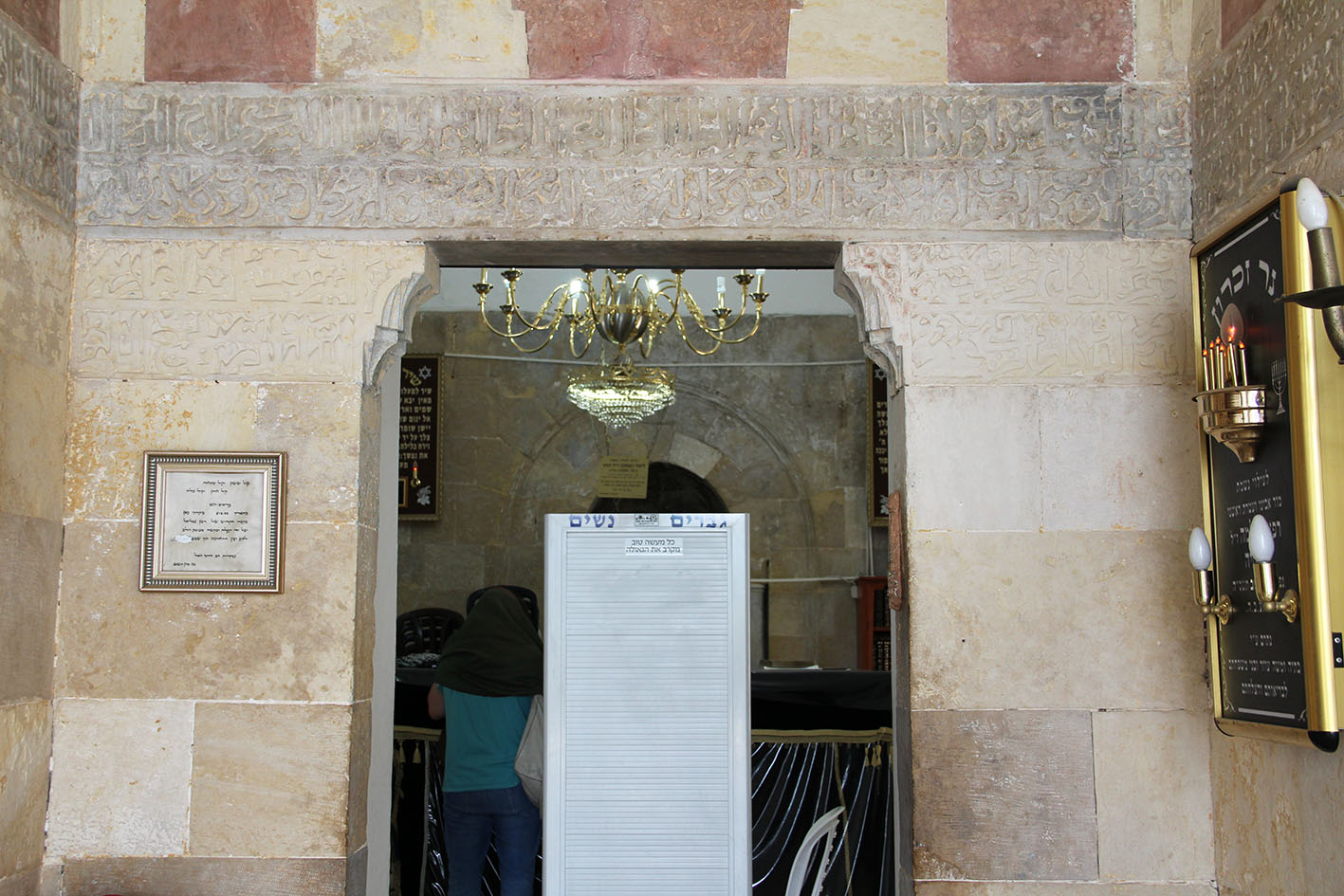
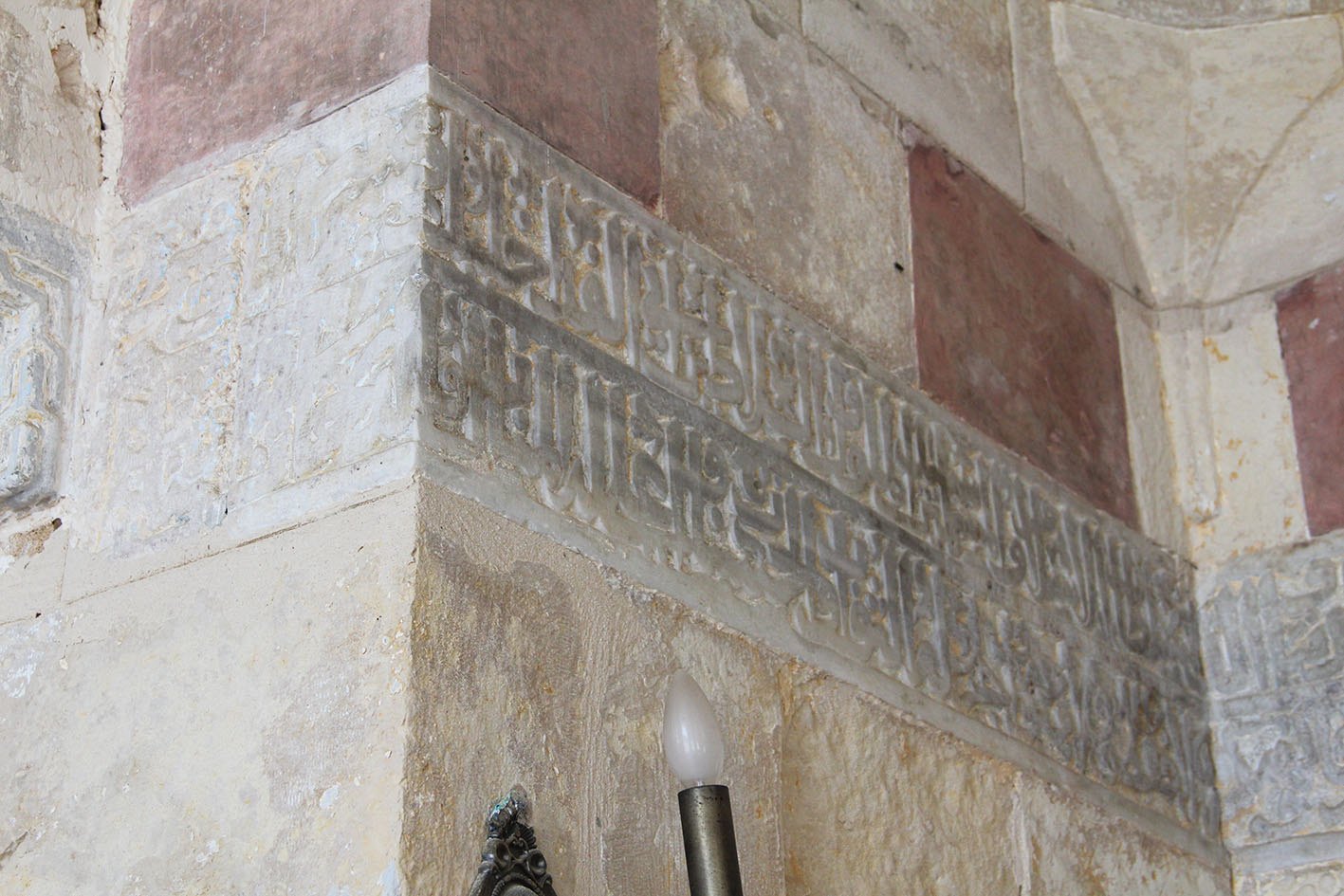
692/1293. Texte de construction 2 lignes sur le linteau de la porte (ill.17-20).[2]
« xxxx ce martyrion
béni, martyrion d’Abu Huraira, - que Dieu soit satisfait de lui ! –
compagnon de l’Envoyé de Dieu, a été fondé par notre seigneur et maître, le
sultan auguste, savant, juste, le champion de la foi, le combattant, l’assisté
de Dieu, le victorieux, al-Malik al-Ashraf Sâlah al-dunya wa’l-dîn, le sultan
de l’Islam et des musulmans, le seigneur des rois et des sultans, Abu’l-Fidâ’
Khalîl, l’associé de l’émir des croyants, - que Dieu glorifie ses
victoires ! – enfant de notre maître le sultan martyr al-Malik al-Mansûr
Qala’ûn al-Sâlihî, que Dieu déverse sur son séjour la pluie de la miséricorde
et de la satisfaction et des délices du pardon, qu’il le fasse habiter les
jardins de l’éternité, lui procure un viatique au jour promis, l’installe sous
une ombre convenable, avec l’eau courante, des fruits abondants, ni détachés de
l’arbre ni défendus, qu’il lui donne un salaire magnifique, et lui destine les
demeures et les rangs les plus élevés, xxx ! l’achèvement de sa
construction eut lieu dans les mois de l’année 692 (1293). S’est chargé de sa
construction Aidamur le dawadâr al-Zainî, qur Dieu lui pardonne, ainsi qu’à sa
postérité et à la totalité des musulmans ! »
Illustrations
|
|
|
|
|
|
|
|
1/ plan du maqâm |
2/ coupes du maqâm |
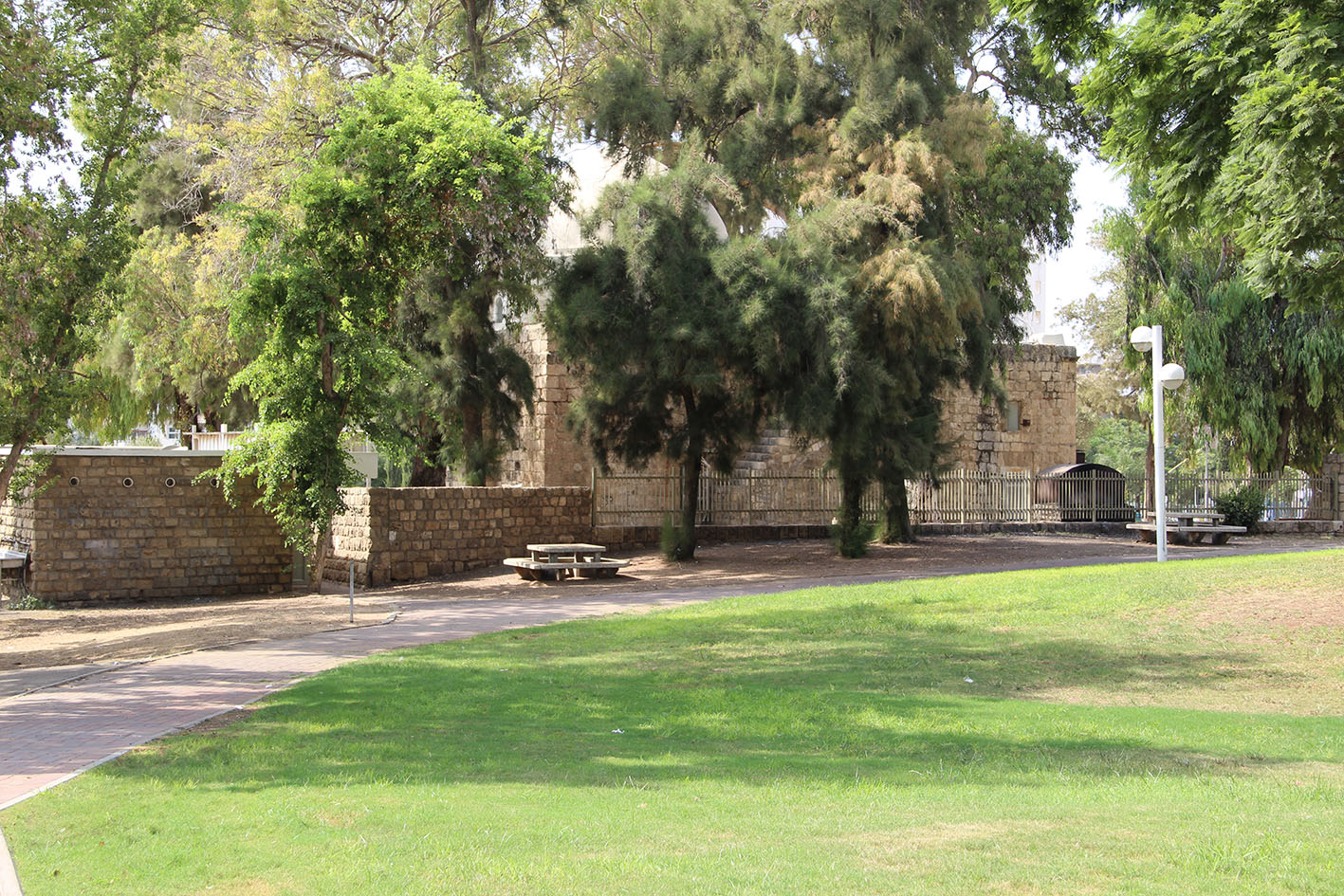
3/ vue du site depuis l’est |
4/ vue sud-est du maqâm |
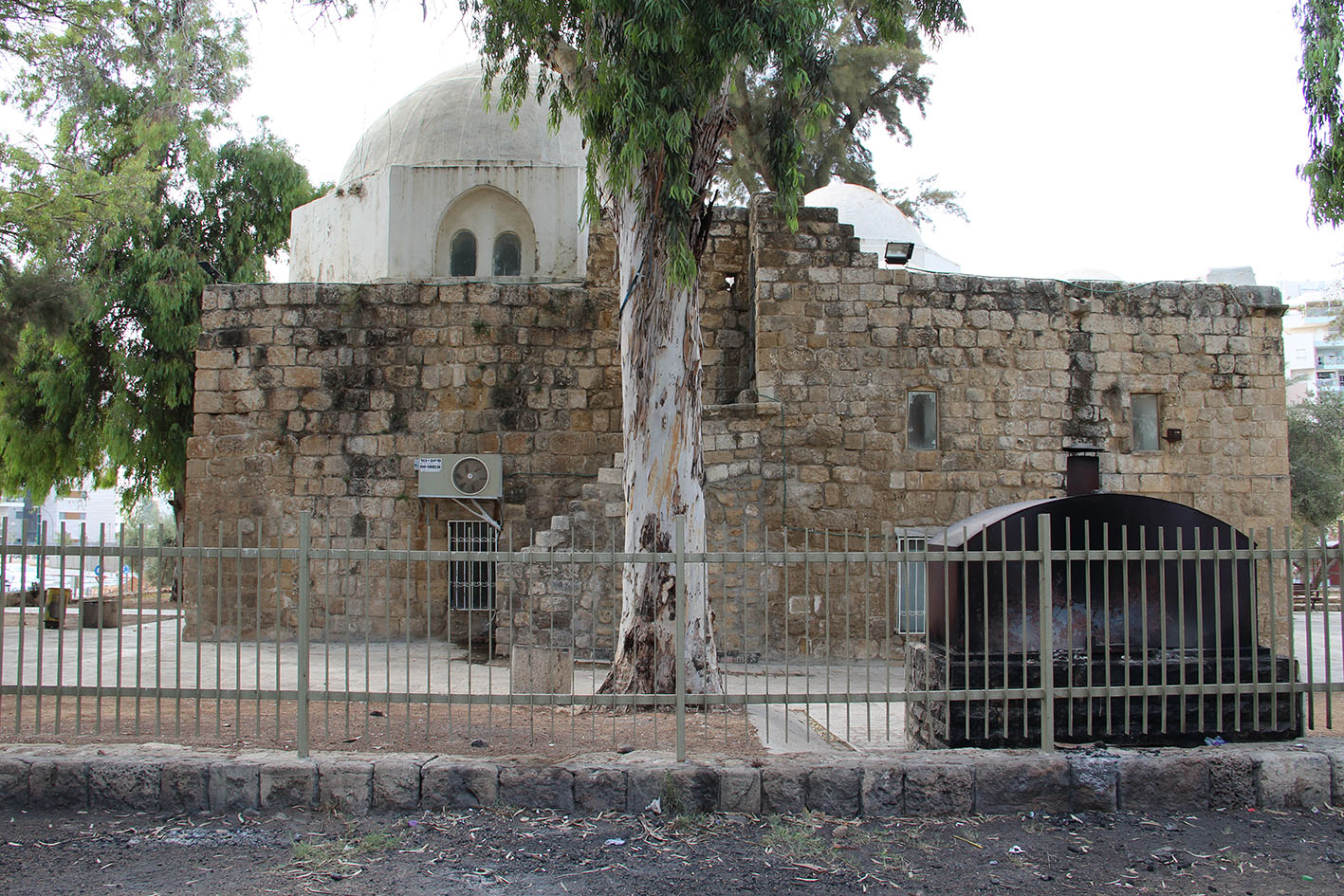
5/ vue de la façade est |
6/ vue depuis le nord-est |
|
|
|
|
|
|
|
|
7/ vue de la façade sud |
8/ vue depuis le sud-ouest |
9/ vue depuis le nord-ouest |
10 façade principale du maqâm |
11/ l’accès au maqâm avec son arc de remploi |
12/ vue du portique avant la salle |
|
|
|
|
|
|
|
|
13/ l’entrée de la salle avec sa coupole |
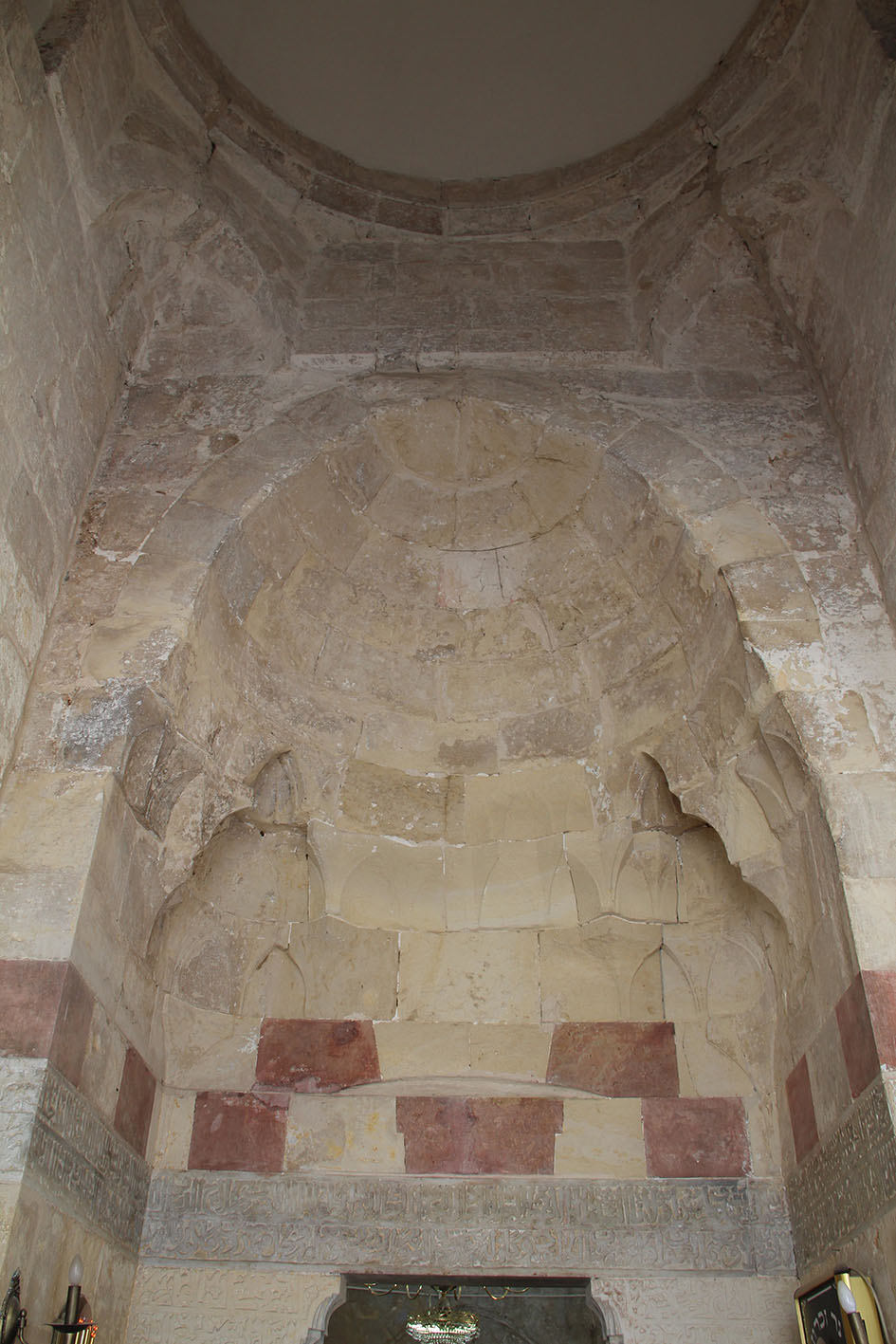
14/ partie haute du portail |
15/ la coupole |
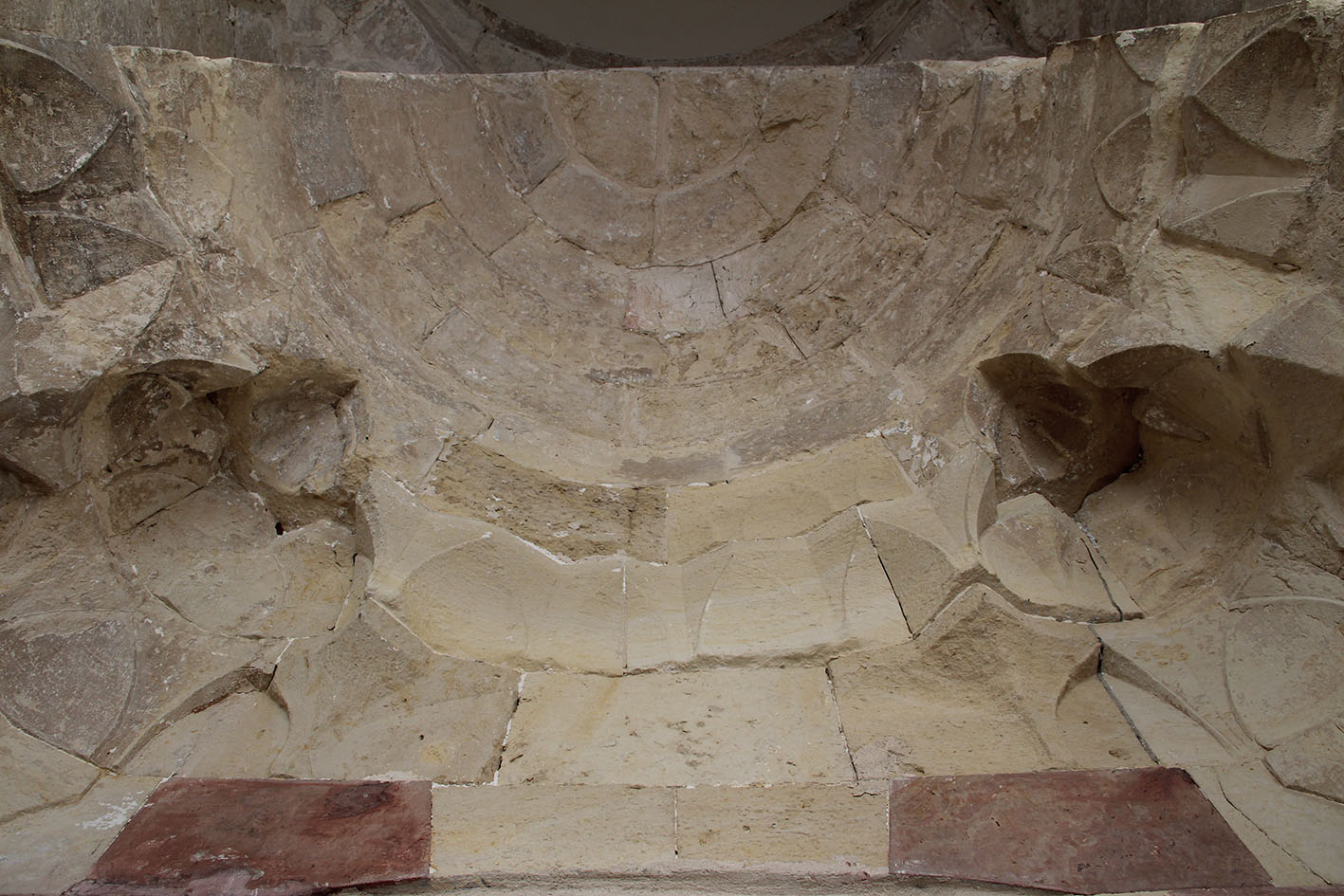
16/ la voûte à muqarnas du portail d’entrée |
17/ la baie du portail avec l’inscription datée
692/1293 |
18/ partie droite de l’inscription de construction
datée 692/1293 |

|
|
|
|
|
19/ partie centrale de l’inscription de construction
datée 692/1293 |
20/ partie gauche de l’inscription de construction
datée 692/1293 |
21/ l’inscription de construction datée 673/1274
conservée au Musée National |
Documents anciens
Clermont-Ganneau (1896), II, p.167-168,
177-181. Visite en 1870 et 1873.
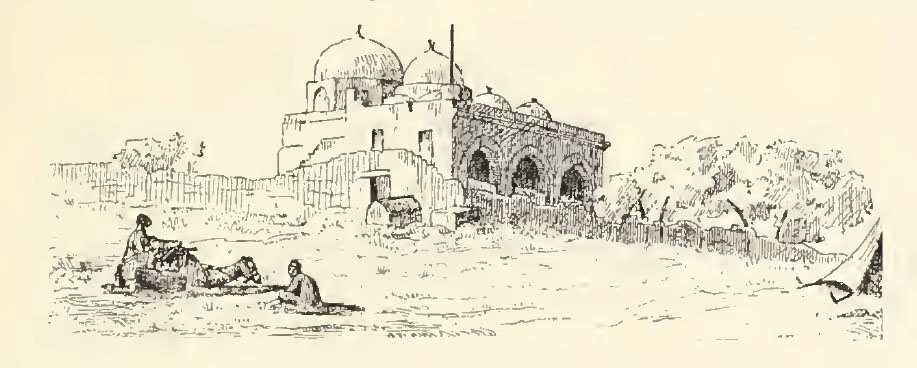
At Yebna we pitched our tent near the wely of Abu Horeira. Inside this
we noticed numerous fragments of marble, several stones with the medieval
tool-marking, and two marble columns surmounted by their capitals. The outside
of the building is rather a picturesque sight, with its lewain of three arches,
its cupolas and its courtyard planted with fine trees. The consecration of the
Sanctuary to the famous Abu Horeira, "the father of the little she
cat," the companion of Mohammed, though it can be and has been disputed,
and is certainly spurious, must date very far back.
These pages, devoted to the description of Yebna, were already gone to press when I had sent me a series of observations of the highest interest, which serve to remedy the incompleteness of my own, and confirm on several essential points the archaeological and historical conclusions I had drawn from them. M. Max van Berchem, whose name I have already mentioned in speaking of the Lydda bridge, has been so kind as to undertake to supply the desiderata I had pointed out to him for the description of the monuments of Yebna. He has studied them on two occasions, in 1893 and in 1894, the first time with the assistance of his young and courageous wife, whose untimely loss his friends unite with him in deploring. In the following lines I give the substance of the precious notes that he has placed at my disposal, and I am happy to thank him publicly for this graceful act.
The Wely.—A. " On the door of the enclosure of the wely, east
side, is a large marble slab (1"" 05 by 0"" 70), with five lines of fine old Mameluke neskhy characters ; the letters are flat, white on a yellow ground, and have
a few diacritical marks.
" In the name of the merciful and pitiful God.
Gave the order to begin building the blessed porch (rewaq), our master, Sultan El-Malek edh-Dhaher,
pillar of the world and of religion, Aboul Path (the father of conquest)
Beibars, co-sharer with the Emir of the Believers, may God exalt his victories
! The completion of it took place in the month Rebi' I, in the year six hundred
and seventy-three. Was entrusted with the building Khalil son of Chawer,
Governor of Ramleh, whom may God pardon, him, his father and mother, and all
the Mussulmans."
"The proper name is as a matter of fact written Khalîl ben Sawr
but as many diacritical marks are wanting, there is no objection to reading Chawer.
B. " In the base of the doorway, consequently under the porch that
is in front of this, on the lintel of the door and on the sides of the bay.
Length of front side 2'" 20, length of the sides, 1'" 10. Two lines
of fine neskhy Mameluke
characters ; letters of medium size, numerous points, few vowels ; the
inscription is whitewashed and very indistinct, though very well
preserved […] " Underneath the lintel, on the right and left sides of
the door, are two lines" :
" In the name of the merciful and pitiful God.
Began to build this blessed sanctuary (meshhed) of Abu Horeira, may God
receive him, companion of the apostle of God, on whom be prayers and salvation,
our Lord and our master the very great, learned, and just Sultan, resolute
champion and guardian (of Islam), victorious, El-Malek el-Achraf, prosperity of
the world and of religion, Suhan of Islam and of the Mussulmans, lord of Kings
and Sultans, Abu '1-Feda Khalil, co-sharer with the Emir of the Believers, may God
exalt his victory, son of our master the Sultan, hero of the holy war, El-Malek
El-Mansûr Kelaun es-Salehy, may God water his reign with the rain of his mercy
and his grace and the benefits of his indulgence, may he make hini to dwell in
the gardens of Eternity, may he come to his aid on the day of resurrection, may
he make him a place under a wide shade with abundant water and quantities of
fruit without stiftt, may he grant him the reward and the delights he has
deserved, may he raise his places and degrees into the .... Amen ! The building
of it was finished in the months of the year six hundred and ninety-two, and
there was entrusted with its building Aydemir the dewadar ("bearer of the
inkstand") Ez-Zeiny (?) may God pardon him, him and his descendants, as
also all Mussulmans."
C. To the left of the great inscription of Beibars (which is above the
door of the enclosure) there is built into the wall another inscription
consisting of three lines cut on a marble slab, length 0'" 46 ; height
0'" 22. Small characters, in cursive Mameluke neskhy.
" Renewed this pool, the conduit and the sakia, his Excellency En-Nasery
(= Naser ed-din) Mohammed Anar (?), son of Anar (? ?), and his Excellency
El-'Alay = 'Ala ed-din) Yelbogha, possessors (?) of the township of Yebna, may
god in his grace and mercy grant to both of them Paradise as a reward. Ordered
at the date of the month Rebi' I, in the year eight hundred and six (1403
.a.d.)."
Being exposed at each of his visits to the hostility of the fellahin,
who were set on him by the sheikh, M. M. van Berchem was unfortunately unable
to carry out all the archaeological observations in the wely which I had
requested him to make in order to ascertain whether there really were, as I
supposed, materials in the structure borrowed from the old Crusaders' church.
On the first occasion his suspicions were aroused, on the second he managed to
note certain details which seem to me to give support to my conjecture.
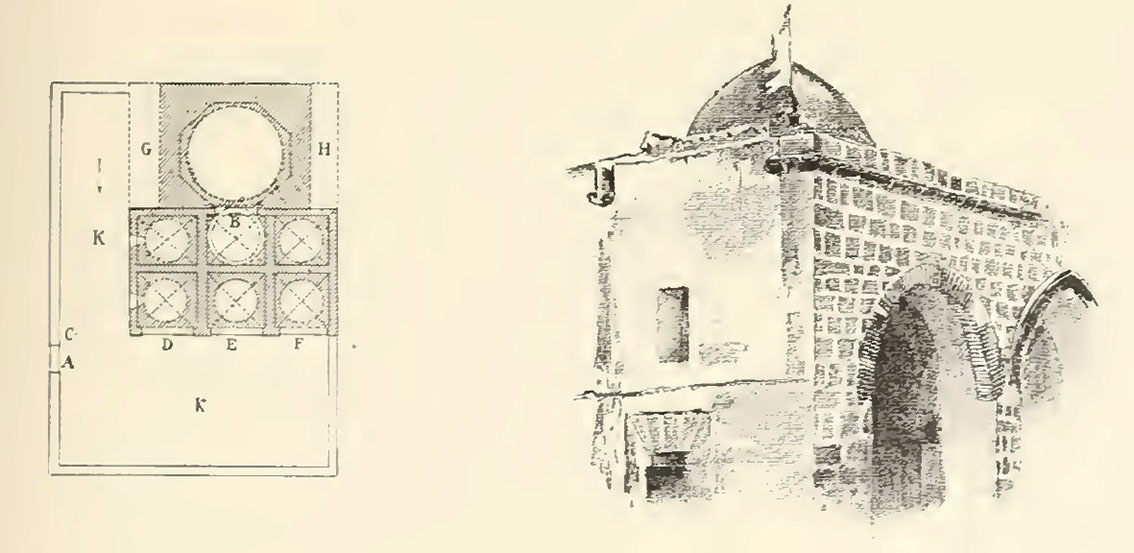
Here, firstly, is a small sketch made from his notes in combination
with our own, and giving a plan of the sanctuary, approximately correct, and
showing the position of the three inscriptions reproduced above (a, b, c).
K K is an enclosure open to the sky. I add to this a partial view of
the edifice made from two small photographs which M. M. van Berchem succeeded
in taking, in spite of riotous opposition, which at one time nearly took a
fatal turn.
The rewaq mentioned in inscription a is evidently the
porch with three arches d, e, f, and two bays (each about lo feet wide), which
stands in front of the sanctuary proper. The whole is formed of six groined
compartments, and each surmounted by a small cupola. M. M. van Berchem
estimates the width of the fagade at about 32 feet.
Here follow the notes made by M. M. van Berchem :
" I searched for Crusaders' blocks in the side and rear walls (G,
H, l), and I think I saw some in the front wall H, but I am not certain. Here
are some details concerning the arches, D, E, F, of the portico. The central
arch E, which,
"brisé" at the top, is composed of two quite distinct parts :
i. A moulding M, formed of a fillet and a cavetto ; middle joint at the top of
the arch ; lengthened voussoirs. This moulding appeared to me Gothic, but I
cannot assert as much, not having been able to examine it closely. 2. An
archivolt N placed against the intrados of the preceding, with narrower
voussoirs, and a voussoir at the top (key-stone) V. The front of the voussoirs
is ornamented with a zig-zag line cut in the stone, and following the curve of
the arch … The joints of the upper moulding do not coincide with those of the
lower archivolt. The two side arches, D, F, have the "pudding"
ornamentation. " At the top of the shorter front (about 20 feet above the
level of the ground) runs a cornice, which in its profile recalls the moulding
of the central arch."
I consider that these three arches are sufficiently established as
being of mediaeval origin by their shape, the profile of the mouldings, the
patterns of their ornamentation, and the placing of arches with vertical joints
over arches with keystones. The two latter characteristics are notably present
in the door of the church at Yebna which I have given above. The arch of the
latter, moreover, shares with the two arches D, E, of the wely, the peculiarity
of being very slightly broken. I will add further, that the profile of the
cornice that runs along the top of the façade, simple though it is, is in no
way Arab, and bears a much greater resemblance to a Gothic string-course.
It will be admitted that these facts add considerable weight to the
notion I put forward, that the portico built by order of Beibars was for the
greater part constructed from materials taken from the Crusaders' church, which
at the same time, doubtless, was drawn upon for the bridge, situated not far
away. The commemorative inscription was probably built in the first place into
the portico itself, either on the front or under the arcades, and afterwards,
upon occasion of some rebuilding, it was transferred to the place above the
lintel of the door of the outer enclosure, which it occupies today. The
sanctuary proper, or meshhed, which was built nineteen years later— in
pursuance perhaps of some original plan left unfinished by Khalil ben Shawer—must correspond to the part of the structure marked B, G, I, H, which
is surmounted by the principal cupola.
|
|
|
|
Vue du maqam dans les années 1870 Source : Clermont-Ganneau (1896), II |
Plan du maqâm d’après Ch. Clermont-Ganneau Source : Clermont-Ganneau (1896), II |